
Free shipping -30% PRO 

Starlight lasers G1 Pro768× sold
Starlight Lasers G1 Pro green laser pointer with pattern lens
- Green 532 nm
- 1 mW
- 18650
£99.95£69.95
In stock
HalloweenUse code HALLOWEEN5 for 5% off, valid until 31 October.
Few things are as magical as showing someone their first planet or constellation. A green laser pointer can help – if you know what to expect from a class 2 laser. Here is our honest guide to using a star laser pointer for astronomy.

Our most chosen laser: rechargeable, green, with two safety keys


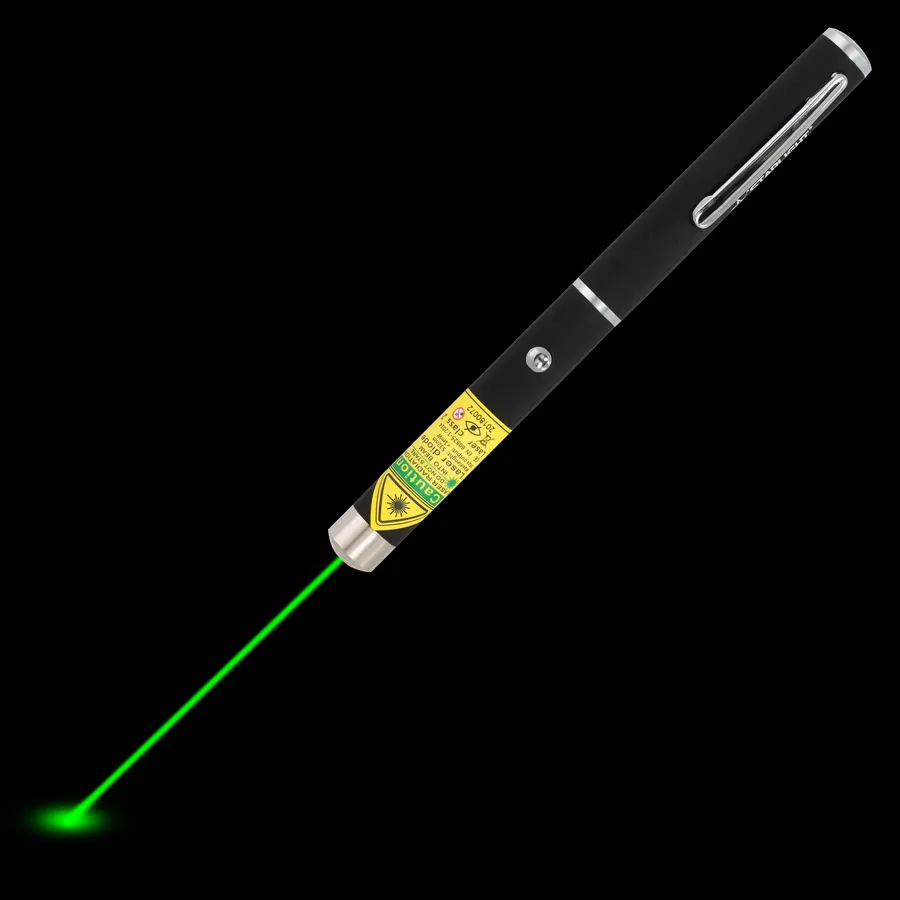


All our lasers have an output up to 1 mW, laser class 2 – the class intended for sale to the public in the UK. That is a sensible, family-friendly level, but it means the beam itself is faint. In very dark, humid air – a moonless night in the countryside, often with a little dew – the green beam can be faintly visible as a thin line towards the sky. In town, under street lights or on dry, clear evenings, you will mostly not see the beam at all.
So how do we use one for astronomy? Mostly in smaller, more personal ways:
Green (532 nm) is the colour the human eye sees most easily, so it is the only sensible colour for night-sky use. The dot is visible at approx. 1 km in the dark and approx. 300 m at dusk (indicative). Red and violet reach much less far.
| Situation | Visible dot |
|---|---|
| Indoors | 30 m+ (a whole room or hall) |
| Daylight (dot on a shaded surface) | approx. 100 m |
| Dusk | approx. 300 m |
| Dark | approx. 1 km (dot); beam faintly visible only in very dark, humid air |
Tip: Li-ion batteries do not like the cold. Keep the laser in an inside pocket between uses and bring a charged spare, such as a PowerFox 18650 2-pack.
Before you point anywhere near the sky, look and listen for aircraft – including helicopters and drones – and never aim at them. In the UK it is a criminal offence to shine a laser at an aircraft or vehicle. Do not use a laser near airports or flight paths. Never point at people's eyes, and keep the laser away from children; it is not a toy. Read more on the laser pointer safety page.
Pick a moonless night, drive or walk away from street lights, and give your eyes twenty minutes to adapt. Start with the easy wins: the Plough, Orion in winter, or a bright planet low in the sky. Stand shoulder to shoulder with your companion, point the dot at a tree or rooftop just below the object, and describe the shape from there. If the air is damp and the night very dark, you may catch the faint green line too.
Many astronomy clubs have their own rules about lasers at observing sessions – check before you bring one along. Enjoy the sky! More outdoor ideas: long range laser pointer.
We use cookies to run the shop, measure how it is used and see which ads work. You choose what you allow. Privacy policy
AI assistant: can make mistakes. Prefer a person? Just ask.